Groin Pain When Walking? 4 Signs Your Hip Joint Needs Attention

“Why does my hip hurt every time I walk?”
“I thought I pulled a groin muscle, but the pain keeps coming back.”
“It is becoming difficult to put on my socks or lift my leg into the car.”
Pain in the front of the hip or deep inside the groin is often mistaken for a tight hip flexor or a simple muscle strain. Sometimes that is exactly what it is—especially after an unfamiliar workout, a long hike in the beautiful Coquitlam trails, or a sudden increase in activity.
However, when the pain keeps returning, affects your walking, or makes everyday movements progressively more difficult, the hip joint itself may need closer assessment.
This does not automatically mean that you have arthritis or another serious condition. Muscles, tendons, the lower back, nerves, and structures inside the hip joint can produce similar symptoms. The important question is not simply, “Where does it hurt?” We also need to understand which movements reproduce the pain, how well the hip accepts weight, and whether the pelvis or lower back is compensating.
Where Is Hip Joint Pain Usually Felt?
The hip is a deep ball-and-socket joint where the head of the thigh bone (femur) meets the pelvis. Pain related to the hip joint itself is commonly felt in the:
· Deep groin
· Front of the hip
· Upper thigh
· Buttock
· Thigh extending toward the knee
Hip osteoarthritis commonly causes groin or thigh pain, stiffness, reduced range of motion, difficulty walking or bending, and sometimes a limp. Some people also experience catching, sticking, or discomfort after prolonged sitting or increased activity (AAOS OrthoInfo, 2020).
Pain location alone cannot confirm the cause. That is why a professional assessment should consider hip movement, strength, walking gait, weight-bearing, and relevant medical history together.
4 Signs Your Pain May Be Coming From the Hip Joint

1. Deep Groin Pain When Walking or Bearing Weight
The hip supports a large amount of body weight with every step. When the joint is irritated or no longer moving comfortably, you may experience a deep ache, pressure, burning discomfort, or pinching sensation during activities such as:
· Walking for longer periods.
· Standing
on one leg.
· Climbing stairs.
· Hiking on uneven ground.
· Getting up from a low chair or a soft sofa.
· Stepping into or out of a car.
Some people feel relatively comfortable while sitting but develop pain as soon as they begin walking. Others notice that the first few steps are particularly stiff or uncomfortable.
These symptoms can occur with hip osteoarthritis, but muscles, tendons, and movement patterns around the pelvis can also contribute. An assessment can help determine whether the pain is primarily related to the joint, the surrounding tissues, or a combination of both.
2. One Hip Feels Stiffer When You Turn the Leg
A gradual loss of hip rotation can be an important sign that the hip is not moving as freely as it should. You may notice that:
· One foot turns outward more while walking.
· One hip feels tighter or pinches during a golf swing follow-through.
· Deep squatting causes a sharp pinch in the groin.
· Certain yoga positions feel blocked on one side.
· Changing direction quickly produces catching or sharp pain.
· Crossing one ankle over the opposite knee is more difficult.
Reduced or painful internal rotation is one of the movements commonly assessed when hip osteoarthritis is suspected (Aging Research Biobank, 2018). However, reduced rotation can also result from muscle guarding, previous injuries, joint shape, or pain sensitivity, so it should not be interpreted in isolation. Comparing both hips helps us understand whether the restriction is coming mainly from the joint, the surrounding muscles, or compensation through the pelvis and lower back.
3. It Is Becoming Harder to Put On Socks or Lift Your Knee (Restricted Flexion)
Hip flexion is the movement used to bring the thigh toward the body. When this movement becomes painful or restricted, everyday tasks may become difficult, including:
· Putting on socks or shoes.
· Tying hiking boots.
· Sitting in a low chair.
· Stepping into a bathtub.
· Lifting the leg into a car or raised vehicle.
· Bringing the knee toward the chest.
The body often compensates by rounding the lower back, leaning to one side, or rotating the pelvis. Over time, these compensations may contribute to lower-back stiffness or discomfort around the opposite hip.
This is one reason that repeatedly stretching only the painful area may provide temporary relief without addressing the full movement problem. Some painful hips need mobility work, while others need better muscle activation, load management, or medical investigation.
4. The Pain Is Affecting Sleep or Causing a New Limp
Hip pain that regularly wakes you at night, continues at rest, or causes a new limp deserves further attention. Night pain does not automatically mean that a serious condition is present. Osteoarthritis and other musculoskeletal problems can become painful at night, particularly after a physically demanding day.
However, further medical assessment may be appropriate when the pain is progressively worsening or accompanied by:
· Increasing difficulty bearing weight.
· A new or unexplained limp.
· Rapid loss of hip movement.
· Previous significant hip trauma.
· Long-term corticosteroid use.
· Heavy alcohol consumption.
· A history of conditions affecting bone circulation.
These factors may increase clinical concern about osteonecrosis, also known as avascular necrosis (AVN).
Why Avascular Necrosis (AVN) Should Be Identified Early
Most cases of hip or groin pain are not caused by avascular necrosis. However, AVN is important to consider when persistent hip pain occurs together with relevant risk factors.
Avascular necrosis develops when the blood supply to the femoral head is temporarily or permanently disrupted. Without adequate circulation, part of the bone begins to die and gradually loses its structural strength. As the condition progresses, small fractures can develop beneath the joint surface. The femoral head may begin to flatten or collapse, damaging the cartilage and eventually causing severe secondary arthritis (AAOS OrthoInfo, 2021).
This is different from the typical hip fracture that occurs after a fall. In AVN, structural damage develops within the femoral head, sometimes over several months or years. Once the femoral head has collapsed, preserving the natural joint becomes much more difficult, and total hip replacement may eventually be required. Earlier identification generally provides more conservative treatment options than waiting until collapse has occurred (AAOS OrthoInfo, 2021).
For this reason, persistent hip pain should not simply be covered up with pain medication without considering why it continues to return.
Furthermore, maintaining walking ability is key to preserving your active BC lifestyle. Longevity and overall health are deeply connected to our mobility. In clinical studies, reduced mobility in older adults is associated with a greater risk of losing physical independence (Hirvensalo et al., 2000). Protecting your mobility through early intervention is an essential pillar of healthy, active aging.
Acupuncture may help manage pain and protective muscle guarding while a patient undergoes appropriate medical assessment. However, suspected AVN requires medical investigation and imaging (such as an MRI).
When Should You Seek Urgent Medical Care?
Acupuncture, stretching, or exercise should not delay appropriate medical care. Seek urgent medical attention when:
· You suddenly cannot walk or place weight on the leg.
· Severe pain began immediately after a fall, collision, or other injury.
· The hip joint area is hot, visibly swollen, or red.
· Hip pain is accompanied by fever or feeling generally unwell.
· The leg appears shortened, rotated, or deformed.
· Pain is rapidly worsening without a clear reason.
· You develop significant numbness or weakness after an injury.
Persistent pain that is affecting your sleep, walking, or daily activities should also be discussed with an appropriate healthcare professional, even when it is not an emergency.
Can Acupuncture Help Hip Osteoarthritis?
Yes.
Acupuncture can be a valuable part of conservative care for people with hip osteoarthritis, particularly when pain and stiffness make it difficult to walk, sleep, exercise, or manage everyday activities.
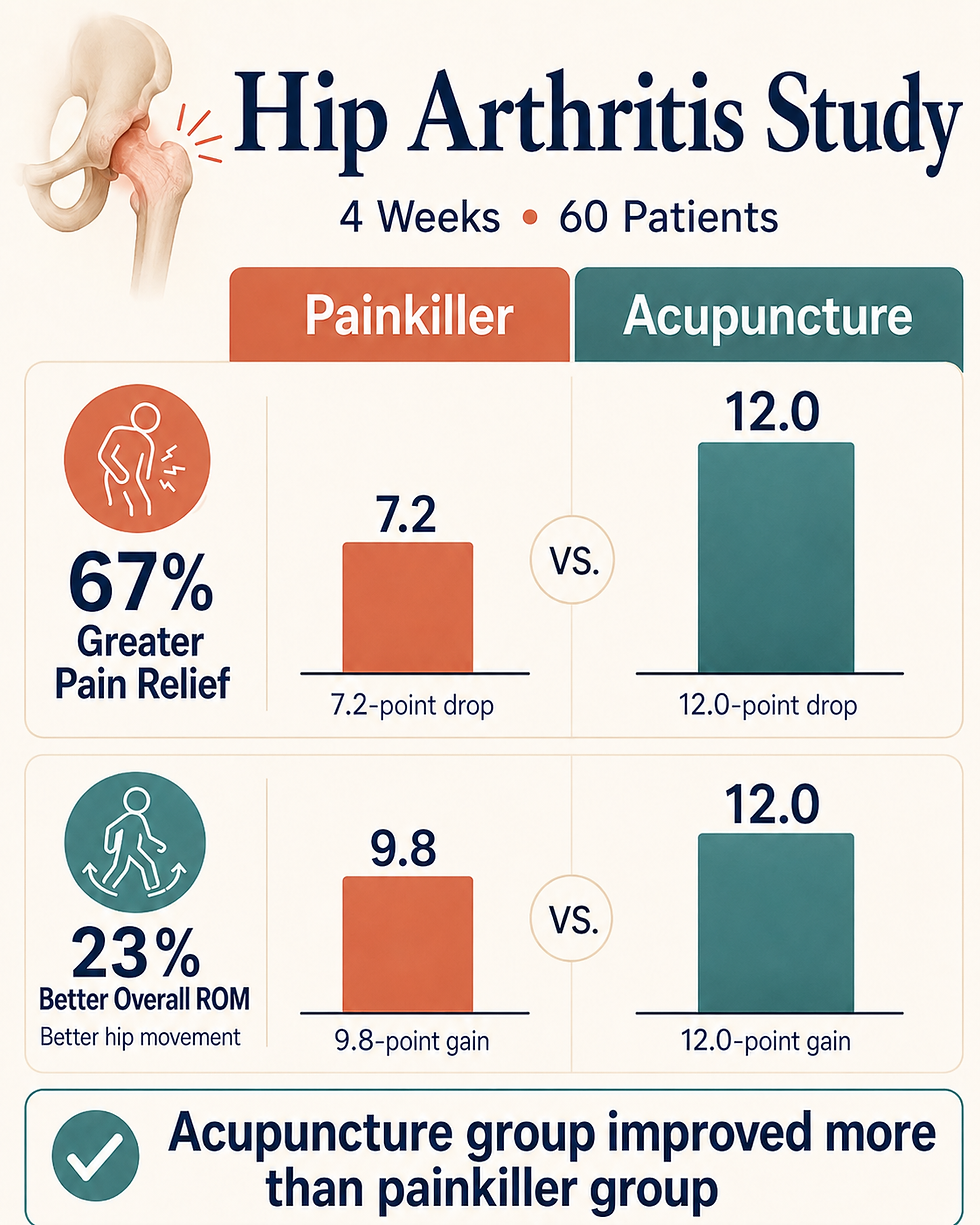
In a randomized clinical trial involving patients with hip osteoarthritis, four weeks of electroacupuncture significantly reduced pain and improved hip function and range of motion. The electroacupuncture group showed greater improvement in pain and functional scores than the control group taking oral diclofenac, a commonly used anti-inflammatory medication (Wang et al., 2011).
Acupuncture does not regrow damaged cartilage or change the structural shape of an arthritic joint. Its practical value is in helping to:
· Reduce localized pain sensitivity.
· Calm protective muscle tension (hypertonicity) around the joint.
· Improve overall tolerance of movement.
· Support more comfortable walking and gait mechanics.
· Make appropriate strengthening exercise easier to perform.
· Reduce reliance on pain medication for some patients.

When pain becomes more manageable, patients are often better able to remain active and continue the targeted exercises needed to maintain hip, gluteal, and core strength. Acupuncture is therefore not simply about temporarily covering the painful area; it is integrated into a broader rehabilitation plan that includes movement assessment, activity modification, and medical follow-up when necessary.
Acupuncture Before and After Hip Replacement Surgery
Patients who have already scheduled hip replacement surgery do not necessarily need to endure severe pain without support while waiting for their procedure on the BC medical waitlist.
Pain before surgery can reduce walking, disturb sleep, increase anxiety, and contribute to a loss of strength and physical conditioning. Maintaining the best possible level of comfort and movement before surgery may help patients enter the recovery period in a stronger condition.
A randomized clinical trial involving patients preparing for total hip or knee replacement found that preoperative acupuncture reduced surgery-related anxiety and pain, with high patient satisfaction (Bae et al., 2014).

Research has also examined acupuncture during and after hip replacement surgery:
· During Surgery: In one randomized trial, patients who received auricular acupuncture during total hip replacement required approximately 15% less fentanyl (an opioid painkiller) during surgery than the control group (Wetzel et al., 2011).
· After Surgery: Another study found that auricular acupuncture after total hip replacement significantly reduced the amount of postoperative pain medication required during the first 36 hours after surgery (Wetzel et al., 2011).
These findings suggest that acupuncture may be useful at several stages:
1. Before surgery: To help reduce pain and surgery-related anxiety.
2. Around the time of surgery: To support multimodal pain management and reduce opioid requirements.
3. After surgery: To help manage postoperative pain and make early movement and rehabilitation more comfortable.
Better pain control does not replace rehabilitation, but it may help patients participate more comfortably in walking, mobility exercises, and other crucial parts of their recovery program. Acupuncture should always be coordinated with your surgeon’s instructions and does not replace prescribed medication, wound care, or postoperative physical therapy.
Our Approach at Core Medical Acupuncture in Coquitlam
At Core Medical Acupuncture, we do not assume that every patient with groin pain has the same problem. We look at your body as an integrated movement system. Your comprehensive assessment may include:
· The precise location and pattern of your pain.
· Hip range of motion (flexion, internal and external rotation).
· Comfort with walking, weight-bearing, and gait analysis.
· Symmetry and structural differences between the left and right sides.
· Pelvic and lower-back compensation patterns.
· Hip, gluteal, and trunk muscle activation.
· Previous injuries and relevant medical history.
· Screening for signs that medical imaging or physician referral may be appropriate.
When acupuncture is appropriate, treatment may be used to reduce pain sensitivity and excessive muscle guarding around the hip. We combine targeted needle stimulation with gentle manual techniques and individualized movement guidance to help you gradually return to walking, work, hiking, and daily activities with greater confidence.
Persistent Hip or Groin Pain Keeping You Off the Coquitlam Trails?
Don't let joint stiffness limit your active lifestyle or leave you waiting in pain. Book a thorough movement and orthopedic assessment at Core Medical Acupuncture in Coquitlam today.
👉 [Book an Assessment]
Scientific References:
1. American Academy of Orthopaedic Surgeons (AAOS) - OrthoInfo. (2020). Inflammatory Arthritis of the Hip. [Available online]
2. American Academy of Orthopaedic Surgeons (AAOS) - OrthoInfo. (2021). Osteonecrosis of the Hip. [Available online]
3. Wang, T., & Zhao, L. (2011). Comparative observation on hip osteoarthritis treated with electroacupuncture and medication. Journal of Acupuncture and Tuina Science, 9(1), 41–44.
4. Hirvensalo, M., Rantanen, T., & Heikkinen, E. (2000). Mobility difficulties and physical activity as predictors of mortality and loss of independence in the community-dwelling older population. Journal of the American Geriatrics Society, 48(5), 493-498.
5. Bae, H., et al. (2014). Acupuncture for the relief of preoperative anxiety and pain in patients preparing for total joint replacement. Journal of Clinical Acupuncture.
6. Wetzel, B., et al. (2011). Auricular acupuncture for pain relief after total hip arthroplasty: a randomized controlled study. Anaesthesia, 66(12), 1153-1159.
Disclaimer: This article is provided for general educational purposes. It does not replace medical diagnosis, imaging, emergency care, orthopedic consultation, or advice from your physician or another qualified healthcare professional.


Comments