Knee Pain and Foot Mechanics: Why We Look Beyond the Knee

Ethan(Byungkoan) Ro · Registered Acupuncturist (B.C.) · Doctor of Korean Medicine · Member of Cyriax Orthopaedic Medicine (Korea) · D.O. (NUMSS, Spain) Clinical Practice Since 2008
Imagine you come to see me because your knee hurts.
Naturally, you expect me to start by examining your knee. But instead, I ask you to stand up—and I begin by looking at your feet.
You may wonder,
“Why are you looking at my feet when my knee is the problem?”
The reason is simple: the knee does not work alone.
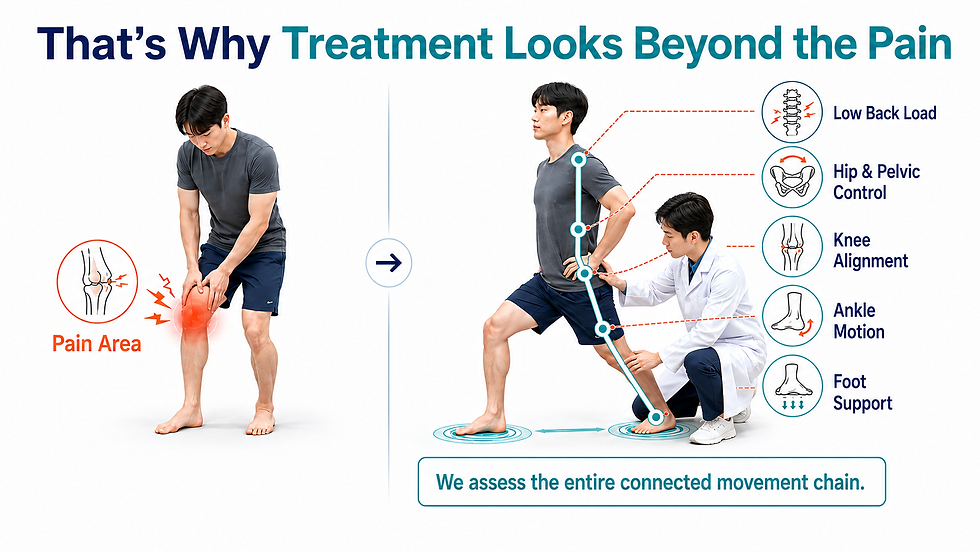
When you stand, walk, climb stairs, or get up from a chair, your foot is where your body first meets the ground. From there, load travels through the ankle and knee to the hip and pelvis.
If one part of this system is not doing its job well, another area may have to compensate.
This does not mean that foot problems always cause knee pain.
It means that the place where you feel pain is not always the only place contributing to the problem.
That is why, when treating knee pain, I may look at your feet, ankles, hips, and pelvis as well as the knee itself.
Why Can the Feet Matter for Knee Pain?
The feet form the base of most weight-bearing movement.
When you walk, your foot has to accept your body weight, adapt to the ground, and then help move you forward.
If that process becomes less efficient, movement can change farther up the leg.
For example:
Foot support → ankle movement → knee movement → hip and pelvic control
A change at the foot does not automatically create pain at the knee.
But it can change how load is distributed through the leg.
For some people, that may mean the knee has to absorb more stress than it otherwise would.
This is one reason why persistent knee pain sometimes requires us to look below the knee—not just at the painful area itself.

Do Flat Feet Cause Knee Pain?
Not necessarily.
Many people have flat feet and never develop knee pain.
The shape of the foot alone is usually not enough to tell us whether it is a problem.
What matters more is how the foot functions when you put weight through it.
A foot may look relatively normal while standing but become unstable during walking or other weight-bearing activities.
On the other hand, a visibly flat foot may function perfectly well without causing any symptoms.
So the goal is not to create a “perfect” arch.
The more useful question is:
Can the foot support the body comfortably and allow the rest of the leg to move efficiently?
If not, the ankle, knee, hip, or pelvis may need to compensate.
The Big Toe and Ankle Can Change the Way the Leg Moves
Even small areas of the foot can influence movement farther up the leg.
The big toe is a good example.
As you walk, your body moves over the foot and eventually pushes forward through the front of the foot.
If the big toe is very stiff or is not being used effectively, the body may find another way to move forward.
You might shift weight toward the outside of the foot, alter ankle motion, or create extra movement through the knee or hip.
Ankle mobility can have a similar effect.
If the ankle cannot move comfortably during walking, stairs, or squatting, another joint may have to make up for that missing movement.
Again, this does not mean that every stiff ankle or big toe needs treatment.
It only becomes important when it appears to be affecting the way you move or increasing stress somewhere else.
The Knee Sits Between the Foot and the Hip
The knee is positioned between the foot below and the hip above.
That means both can influence how the knee moves.
If the foot is not supporting the body well, the knee may move differently.
If the hip and pelvis do not control the leg efficiently, the thigh may rotate or shift, which can also change the load through the knee.
This is why knee pain is rarely as simple as saying:
“It is because you have flat feet.”
or
“Your glutes are weak.”
In some people, the foot plays a significant role. In others, the main issue may be coming from the hip or from the knee itself. Often, more than one area is involved, which is why we look at how the whole leg is working together rather than focusing on a single joint.
The purpose of a broader assessment is to understand which of these factors actually matter for that particular person.
Why We May Look at the Hip and Pelvis Too
The hip and pelvis play an important role in controlling the leg during walking, stairs, and single-leg activities.
If the hip does not manage body weight effectively, the knee may be asked to do more.
The pelvis may shift, the thigh may rotate, and the knee may experience a different loading pattern.
But the relationship also works in the other direction.
If the foot does not provide a stable base, the hip and pelvis may need to compensate higher up.
This is why we look at the leg as a connected system rather than treating each joint as if it works independently.
The foot can influence the hip.
The hip can influence the foot.
And the knee sits between them.

Can the Same Idea Apply to Lower Back Pain?
Yes, although we need to be careful not to oversimplify it.
A foot problem does not automatically cause lower back pain.
However, your feet, hips, pelvis, and spine all work together when you stand, walk, bend, and lift.
If one leg does not accept weight comfortably, the pelvis may shift.
If the hips are not contributing enough during bending or lifting, the lower back may have to move more.
Over time, that repeated compensation may become relevant for some people.
This is why even someone with lower back pain may occasionally be surprised when we look at their feet or hips.
We are not assuming that the foot is the cause.
We are asking:
Is another part of the body making the painful area work harder than it needs to?
Why We Treat More Than the Painful Area
If your knee hurts, the knee itself still needs to be examined and treated.
Looking at the whole body does not mean ignoring the painful area.
It means we do not stop there.
If the same pain keeps returning, we may also need to consider whether another area is contributing to the load on the knee.
Depending on the person, that may include:
foot support
ankle mobility
big toe function
hip control
pelvic stability
the way the whole leg handles body weight
The purpose is not to find as many problems as possible.
It is to identify which areas may be placing unnecessary demand on the painful joint.
Whole-Body Treatment Does Not Mean Treating Everything
A whole-body approach does not mean that every joint needs treatment.
It means treatment is based on how different parts of the body are working together.
For one person with knee pain, improving ankle mobility may be important.
For another, the foot may function well and the hip may need more attention.
For someone else, treatment may remain focused mainly on the knee.
The treatment should follow the individual pattern rather than applying the same correction to everyone.
This is also why flat feet, asymmetry, or a certain posture should not automatically be treated simply because they look different.
What matters most is whether they are affecting movement, load, and symptoms.
The Goal Is Better Load Sharing, Not Perfect Posture
There is no single perfect way for everyone to stand or move.
People naturally have different foot shapes, knee angles, hip mobility, and movement patterns.
The goal is not to force the body into an ideal position.
The goal is to help different parts of the body share the work more effectively.
Ideally:
the foot accepts the ground,the ankle allows movement,the knee transfers load,the hip and pelvis control the leg,and the trunk supports the movement above.
When one area contributes less, another area may have to work harder.
For some patients, understanding that relationship is the key to understanding why pain keeps returning.
So Why Am I Looking at Your Feet When Your Knee Hurts?
Because your knee is part of a larger movement system.
The painful area is important, but it may not tell us the whole story.
The way your foot meets the ground, the way your ankle moves, and the way your hip and pelvis control the leg can all influence how much stress reaches the knee.
That does not mean the foot is always the cause.
It means that persistent pain is often better understood by looking at how the body shares movement and load as a whole.
The knee may be where the pain is felt.
But sometimes, looking beyond the knee is what helps us understand why it is being overloaded in the first place.


Comments