Knee Pain Below the Kneecap: Jumper's Knee, Patellar Tendon Pain, and Osgood-Schlatter


Pain below the kneecap is common in athletes, active adults, and growing teenagers.
You may feel it during running, jumping, squatting, stairs, or after sports. Some people notice it only after activity.
Others feel it when sitting with the knee bent for a long time.
This type of pain may be called:
Patellar tendon pain
Patellar tendinitis
Patellar tendinopathy
Jumper's knee
Osgood-Schlatter disease
Anterior knee pain
These are not all the same diagnosis. But they often share one idea:
The front of the knee is receiving more load than it can comfortably handle.
At Core Medical Acupuncture in Coquitlam, we look at this kind of pain from two angles — treating the irritated tissue, and assessing why that tissue is being overloaded in the first place.
Why Does Pain Happen Below the Kneecap?
The kneecap, quadriceps, patellar tendon, and shinbone attachment work together whenever you straighten your knee — standing up, climbing stairs, squatting, jumping, landing, running, or changing direction in sport.
When this area is loaded too much, too quickly, or with poor control, the tissue below the kneecap can become irritated.
In adults and athletes, this often shows up as patellar tendon pain or jumper's knee. In growing teenagers, similar pain may be related to Osgood-Schlatter disease, near the bony bump where the patellar tendon attaches to the shinbone.
The diagnosis matters.
But the bigger question is: why is this part of the knee being asked to take so much stress?
Jumper's Knee and Patellar Tendon Pain
Jumper's knee refers to pain around the patellar tendon, just below the kneecap. It often affects people who jump, run, squat, lift, or train with repeated knee loading.
The pain may start as mild soreness after activity, then sharpen during squats, stairs, running, jumping, lunges, kneeling, or sport training.
Rest, massage, stretching, or a knee strap can help temporarily — but patellar tendon pain usually needs more than symptom relief. The tendon needs the irritated area to calm down, and it needs to be reloaded correctly. If the tendon feels better after rest but the same movement pattern returns, the pain often comes back too.
At our clinic, we don't only ask "where does it hurt?" We also check hip control, glute activation, squat pattern, stair mechanics, calf control, foot pressure, and sport-specific movement to understand why the tendon is being overloaded.
Osgood-Schlatter Disease in Teens
Osgood-Schlatter is different from adult patellar tendon pain. It usually affects growing children and teenagers who play sports regularly, with pain at the bony bump below the kneecap, where the tendon attaches to the upper shin.

Parents often describe it the same way: a bump under the kneecap, pain with running, jumping, kneeling, or stairs, and a child who can still play but keeps having the pain return.
Osgood-Schlatter shouldn't be treated exactly like adult tendon pain — the growth area needs respect, and training load, flexibility, strength, and recovery all matter. But "just wait until they grow out of it" isn't the full answer either. Reducing irritation, adjusting activity, and improving how the hip, knee, ankle, and foot share load gives a growing athlete safer movement and a smoother return to sport.
Why the Hip, Glutes, and Calf Matter
Patients are often surprised when we assess the hip for pain below the kneecap — but the knee doesn't work alone. Squatting, running, jumping, landing, and stairs all depend on the hip and glutes helping control the thigh bone.
Common patterns we look for:
The knee moves forward too quickly during squats
The hip does not hinge well
The knee collapses inward during stairs or landing
The glutes do not activate strongly
The foot collapses and pushes stress upward
The calf cannot control landing or deceleration
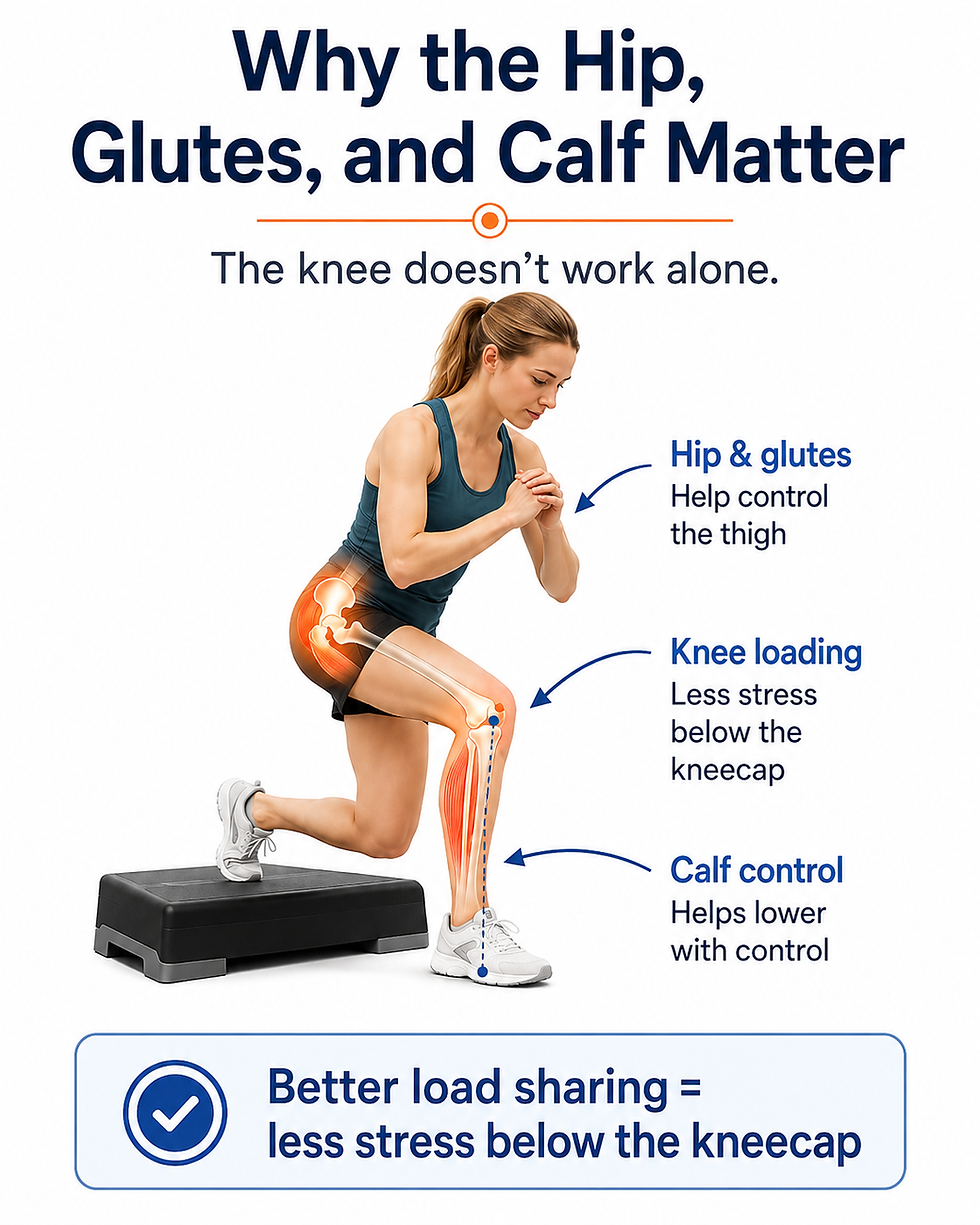
When these patterns are present, the quadriceps and patellar tendon end up doing too much — which is why the pain can calm down after treatment, only to return once the same squat, stair, or landing pattern comes back. Treating both the tissue and the pattern behind it is what breaks that cycle.
How Acupuncture and Rehab Work Together
For pain below the kneecap, acupuncture helps calm pain, reduce inflammatory irritation, improve local tissue response, and create a better window for rehabilitation.
When the tendon or attachment area is irritated, the nervous system often becomes protective — the knee can feel sensitive, tight, weak, or unstable. Acupuncture helps dial down that response so the knee can move with less restriction, which matters because rehab works better once pain is under control. If every squat or landing causes sharp pain, the body can't relearn the movement properly.
But pain relief alone isn't the full answer — if the tendon is overloaded because of poor mechanics, the mechanics still need to change. Depending on the case, rehab may include hip and glute activation, quadriceps loading, controlled squat mechanics, step-up/step-down training, calf control, foot pressure correction, landing mechanics, progressive tendon-loading, and return-to-sport progression.
The goal isn't to avoid using the tendon forever — it's to help the knee handle load again.
Why Rest Alone Often Fails
Rest can reduce pain, but it doesn't automatically improve movement. A runner may rest two weeks and feel better — but if they return to the same stride, hip control, landing pattern, and training volume, the pain can return. The same is true for basketball, volleyball, soccer, gym training, or an active teenager.
Rest calms the tissue. Rehab changes the pattern.
That's why we combine acupuncture with movement-based rehabilitation rather than relying on repeated pain relief alone.
What to Reduce When Pain Is Active
Pushing through sharp pain isn't a good strategy. You may need to temporarily reduce or modify repeated jumping, sprinting, deep squats, heavy lunges, painful stairs, hill running, or sudden increases in training.
This doesn't always mean complete rest — it means the load needs adjusting. The knee needs enough stimulus to recover, but not so much that it keeps getting irritated again.
When to Get the Knee Checked
You should get assessed if you have:
Swelling
Locking or catching
Giving way or buckling
Pain after a fall or twist
Difficulty bearing weight
Pain that is getting worse
Pain that stops sport or daily activity
A teenager limping because of knee pain
A painful bump below the kneecap in a growing athlete
For kids and teenagers, worsening pain, limping, or difficulty participating in sport should not be ignored.
FAQ
Is jumper's knee the same as patellar tendinitis?
Jumper's knee is a common name for patellar tendon pain or patellar tendinitis. It usually refers to irritation of the patellar tendon from repeated jumping, running, squatting, or knee-loading activity.
Is Osgood-Schlatter the same as patellar tendinitis?
No. They can both cause pain below the kneecap, but they are not the same. Osgood-Schlatter usually affects growing teenagers at the bony bump below the kneecap. Patellar tendon pain is more common in adults and athletes.
Can acupuncture help patellar tendon pain?
Yes. Acupuncture helps calm pain, reduce inflammatory irritation, improve local tissue response, and make rehabilitation easier to perform. It works best when combined with the right loading exercises.
Why does my knee pain keep coming back?
Pain below the kneecap often returns when the same stress keeps loading the tendon or attachment area. If hip control, glute activation, calf control, foot pressure, or squat and landing mechanics are not corrected, the irritated tissue can become painful again.
Final Thoughts
Pain below the kneecap is rarely just a small local problem. Whether it's called jumper's knee, patellar tendon pain, patellar tendinitis, or Osgood-Schlatter disease, the bigger question is the same:
why is the front of the knee being overloaded?
Acupuncture calms the irritated tissue. Rehabilitation changes the loading pattern. Together, they give the knee a better chance to recover and stay stronger with sport, stairs, squats, running, and daily activity.
If your knee pain keeps returning, it may be time to look beyond the painful spot and assess the whole movement chain.
Clinical Note
This article is for general education and is not a diagnosis. Severe pain, swelling, instability, trauma-related pain, worsening symptoms, or difficulty bearing weight should be assessed by a qualified healthcare provider.


Comments