Nighttime Calf Cramps: Could Your Standing Posture Be Part of the Problem?

Ethan(Byungkoan) Ro · Registered Acupuncturist (B.C.) · Doctor of Korean Medicine · Member of Cyriax Orthopaedic Medicine (Korea) · D.O. (NUMSS, Spain) Clinical Practice Since 2008
If you keep getting calf cramps at night, magnesium is probably one of the first things you've tried. But what if you're already taking it and the cramps keep coming back?
There may be a simpler question worth asking:
how much work are your calf muscles doing during the day?
Many people who experience frequent calf tightness or nighttime cramps spend much of the day standing slightly too far forward — weight toward the front of the foot, toes gripping the floor, calf muscles working harder than they need to. That doesn't explain every case. But if your calves are overworking throughout the day, changing how you stand may be a surprisingly useful place to start.
Why Standing Posture Can Affect Calf Tension
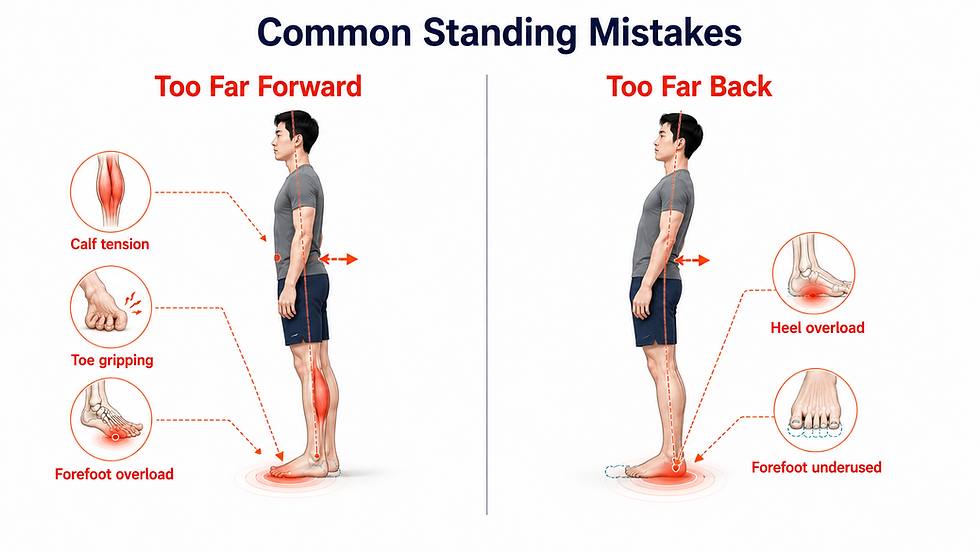
Try standing normally, then slowly shift your whole body slightly forward without bending at the waist. You'll likely notice more pressure moving toward the front of your feet, your toes beginning to grip, and your calves tightening. Your body is simply trying to stop you from falling forward.
A few seconds in this position isn't the problem. Hours of it — without realizing it — is.
A Simple Standing Check
This takes less than 20 seconds. Stand comfortably and notice: are your toes gripping the floor? Do your calves already feel tense?
Does most of your weight feel like it's on the front of your feet?
Then gently move your whole body back, then forward, and find the middle — a position where your heel stays comfortably on the ground, the front of your foot stays connected, your toes can relax, and your calves feel less active. The goal isn't to stand on your heels. It's to find a position where your whole foot shares the load.
Think "Whole-Foot Support," Not "Perfect Posture"
A useful reference is feeling contact through three areas: the heel, the base of the big toe, and the base of the little toe. You don't need to press them into the floor — they should simply remain comfortably connected with the ground, with your toes relaxed.
This is often more useful than trying to "stand up straight" by tightening your core, squeezing your glutes, or pulling your shoulders back. Good standing posture should generally require less unnecessary effort, not more.
You Don't Need to Think About Posture All Day
Constantly trying to hold the "correct" posture can actually create more tension. Instead, use short standing resets a few times throughout the day:
Stand normally
Shift slightly backward
Shift slightly forward
Find the comfortable middle
Relax your toes
It takes 10 to 20 seconds. For some people, returning to this more balanced position regularly is enough to noticeably reduce unnecessary calf activity and improve how the legs feel overall. The benefit comes less from holding one perfect posture and more from regularly reminding the body that it doesn't need to grip or brace all day.
Small Changes Repeated Often Can Matter
If excessive calf activity is being driven partly by how you stand, practicing a more relaxed, whole-foot position several times a day may be a useful form of movement retraining on its own. Think of it as a short reset rather than an exercise session. Ten seconds, several times a day, is often more practical than trying to consciously correct your posture for hours.

Why This Can Matter Beyond the Calf
How you load your foot can influence how your ankle, knee, hip, and pelvis manage body weight. Standing too far forward may increase calf activity, but it can also change how you use your knees and ankles during walking, stairs, and squatting. When symptoms persist, it's worth looking at how the whole body is sharing load — not only where the pain is felt.
What If the Calf Pain or Cramps Continue?
Standing posture is only one possible factor. Nighttime calf cramps and persistent calf pain can also be related to exercise load, hydration, medications, nerve irritation, or circulation problems.
If you've tried improving your standing position but symptoms continue, further assessment may help identify other contributing factors. At Core Medical Acupuncture, we can assess how your feet, ankles, knees, hips, and overall movement pattern may be contributing to persistent calf tension or pain.
Start With One Simple Question
If your calves repeatedly tighten or cramp at night, don't only ask what supplement to take. Also ask: are my calves working harder than they need to during the day?
Stand comfortably. Move gently back and forward. Find the middle. Relax your toes.
Better standing often starts not by adding more effort — but by removing the effort you don't need.


Comments